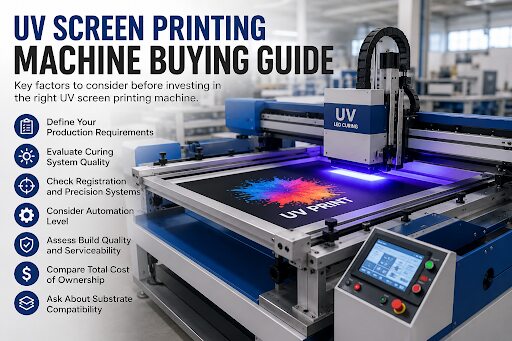
Investing in a UV screen printing machine is a significant decision, whether you’re upgrading an existing production line or setting up a new one. UV curing technology offers real advantages over traditional drying methods — faster cure times, reduced energy consumption in some configurations, and the ability to print on heat-sensitive substrates — but not every machine or setup is right for every business.
This guide walks through the key factors to evaluate before purchasing, so you can make a decision that fits your production needs and budget.
What Is UV Screen Printing and Why Consider It
UV screen printing uses ultraviolet light to instantly cure specially formulated UV inks, rather than relying on heat-based drying tunnels. Because the ink cures almost immediately upon exposure to UV light, production lines can run faster with less risk of smudging between process stages.
Common reasons businesses move toward UV screen printing include:
- Faster turnaround due to near-instant curing
- Reduced substrate distortion, since heat-sensitive materials aren’t exposed to prolonged high temperatures
- Vibrant, durable finishes with strong scratch and chemical resistance
- Lower VOC emissions compared to some solvent-based ink systems
Step 1: Define Your Production Requirements
Before comparing machines, clarify your own needs:
- What substrates will you be printing on most often (plastics, glass, textiles, rigid panels)?
- What’s your expected production volume — is this for prototyping, mid-volume runs, or high-speed industrial output?
- Do you need single-color or multi-color capability?
- Is floor space a constraint, and does the machine’s footprint fit your facility?
Answering these questions first prevents overspending on capability you don’t need — or worse, underbuying a machine that can’t keep up with demand.
Step 2: Evaluate Curing System Quality
The UV curing unit is arguably the most important component of the entire machine, since inconsistent curing leads directly to adhesion failures and quality defects. Look for:
- Adjustable UV intensity and exposure time, allowing you to fine-tune curing for different inks and substrates.
- Even light distribution across the full print width to avoid under-cured edges.
- LED vs. mercury vapor lamps — LED UV systems typically run cooler, last longer, and consume less energy, though mercury vapor systems can offer higher peak intensity for certain heavy-duty applications.
Step 3: Check Registration and Precision Systems
For multi-color work, registration accuracy determines whether your prints look professional or sloppy. Ask potential suppliers about:
- Registration tolerance specifications
- Mechanisms used for screen alignment (mechanical, pneumatic, or servo-driven adjustment)
- Ease of recalibration between production runs
Machines with tighter registration tolerances reduce waste from misprinted units, which pays for itself over time in reduced material cost.
Step 4: Consider Automation Level
UV screen printing machines range from manual, single-station setups to fully automated multi-station lines with automatic substrate loading, indexing, and unloading. Consider:
- Manual/semi-automatic machines — Lower upfront cost, suited to smaller operations or prototyping.
- Fully automatic machines — Higher throughput, more consistent quality, and reduced labor dependency, better suited to higher-volume production.
Automation level should match your production volume and labor availability — an over-automated line running below capacity wastes capital, while an under-automated line struggling to meet demand creates bottlenecks.
Step 5: Assess Build Quality and Serviceability
Look beyond the spec sheet to the physical construction and long-term support:
- Frame rigidity affects registration stability over years of operation.
- Availability of spare parts and technical support matters significantly for minimizing downtime.
- Warranty terms should reflect confidence in the manufacturer’s build quality.
- Ease of maintenance access to screens, squeegees, and curing units affects daily operational efficiency.
Step 6: Compare Total Cost of Ownership
Purchase price is only part of the equation. Factor in:
- Energy consumption of the UV curing system
- Ink costs (UV inks can carry a price premium over conventional inks)
- Expected maintenance and replacement part costs
- Training requirements for operators
- Potential downtime costs during installation and commissioning
A slightly higher upfront investment in a more reliable, energy-efficient machine often results in lower total cost of ownership over its operational lifetime.
Step 7: Ask About Substrate Compatibility
Not all UV screen printing machines handle every substrate equally well. If your production involves flexible plastics, glass, or heat-sensitive materials, confirm the manufacturer has proven experience and reference installations printing on those specific substrates — not just general claims of compatibility.
Questions to Ask Before You Buy
- What’s the realistic throughput at our required quality level, not just the maximum rated speed?
- What ongoing consumables (screens, squeegees, UV bulbs) will we need to budget for?
- Can the machine be upgraded or reconfigured as our production needs change?
- What’s the typical lead time for spare parts and service support?
Making the Final Decision
Once you’ve clarified your production requirements and compared machines on curing quality, precision, automation level, and total cost of ownership, request live demonstrations or sample runs whenever possible. Seeing a machine handle your actual substrates and designs tells you far more than a spec sheet ever will.
If you’re in the process of evaluating options, it’s worth reviewing what’s currently available on the market. You can know more about screen printing equipment manufacturers, or explore a dedicated UV screen printing system built for fast curing and consistent industrial output.
Conclusion
Buying a UV screen printing machine is as much about matching the equipment to your specific production needs as it is about comparing specifications. By clearly defining your requirements, scrutinizing curing system quality, evaluating automation level, and calculating total cost of ownership rather than just sticker price, you’ll be well positioned to choose a machine that delivers consistent, profitable production for years to come.