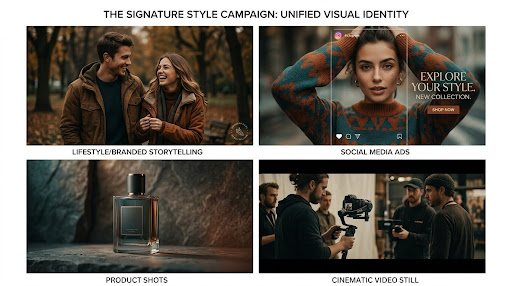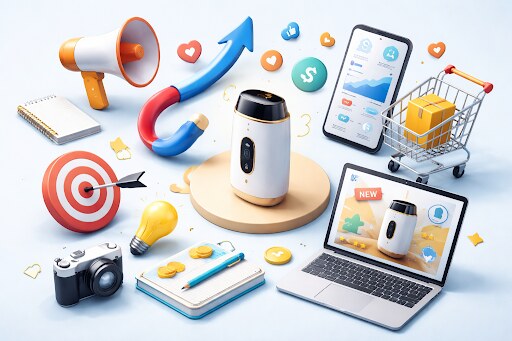
AI image generation has become a normal part of advertising production, but the job is very different from making a good-looking picture for fun. An ad creative has to stop someone, communicate a product or offer quickly, survive feedback from brand and legal teams, and then be adapted into enough variations to keep a campaign alive.
That makes the best advertising tool less about one spectacular output and more about repeatability. Can you keep the product recognizable? Can you create a new composition without rebuilding the entire brief? Can you move from a rough concept to a polished, high-resolution asset? Can another person on the team understand what you did and make the next variation?
For this ranking, we looked at those practical questions first. Image quality still matters, obviously. But in advertising, control and iteration usually matter more than a single lucky generation.
1. Magnific: Best overall for end-to-end ad production
Magnific takes the first spot because it gives ad teams more room to change direction without changing platforms. The current Magnific Creative Suite brings together image generation, editing, upscaling, video, audio, stock assets and visual workflows, so the image generator is not sitting on an island.
The generator itself gives you a broad model selection. Current options include families from Google, Flux, Ideogram, GPT, Seedream, Recraft, Grok, Qwen, Luma and Magnific. That range is useful in advertising because different briefs reward different strengths. A typography-led sale graphic does not need the same model as a luxury product shot or a realistic lifestyle scene.
Magnific is also strong once the first image exists. You can change backgrounds, relight a shot, extend the canvas, create variations, adjust camera perspective and upscale the result. For product and commercial work, Precision upscaling is particularly useful because it is designed to preserve the source rather than invent extra details. When the art direction is more experimental, Creative upscaling can push texture and detail further.
Spaces is what makes the platform feel operational for an ad team. A designer can connect steps into a reusable workflow, while Flows can turn that process into something simpler that teammates can run without rebuilding the logic. That is a much better fit for recurring campaigns than storing prompts in a random document.
2. Ideogram: Best for ads where the words are part of the visual
Advertising often puts image generators into their weakest historical situation: the image needs readable text. A poster, promo graphic, packaging concept or social ad may need a headline to appear inside the composition rather than being added later.
Ideogram has built a strong reputation around exactly that problem. Its newer models are aimed at graphic design, typography and controlled composition, which makes it especially useful during concepting. You can explore a layout where the copy and image are designed together instead of treating the generated visual as a background for text added in another tool.
We would still rebuild important brand typography for final production rather than blindly trusting generated type, but Ideogram is excellent for reaching a strong concept quickly. It is also useful when a client needs to see what a campaign could feel like before a designer spends hours polishing it.
Its weakness compared with Magnific is breadth. Ideogram can be a brilliant specialist inside an advertising workflow, but it is not the same kind of multi-format production environment.
3. Adobe Firefly: Best for agencies that finish everything in Adobe
For many advertising teams, the real workflow starts after the AI generation. Someone has to mask the product, fix small details, build the layout, add legal copy, match brand colors and export a dozen sizes. That is why Adobe Firefly remains one of the most practical options.
Firefly has become a multi-model creative environment while staying closely connected to the Adobe ecosystem. That means a team can explore generative ideas and then move into Photoshop, Illustrator or other familiar production tools without treating AI as a separate department.
The advantage is especially clear in larger agencies and brand teams where Creative Cloud is already approved, deployed and understood. Training a team to use a completely new stack can be harder than adding AI capabilities to software they already use every day.
Firefly is not our top choice here because Magnific offers a more AI-native multi-model workflow and stronger cross-format continuity. But if the people who approve the final ad already live in Photoshop, Firefly deserves to be near the top.
4. ChatGPT Images: Best for turning a creative brief into iterations
A lot of marketers do not think in prompts. They think in feedback: make the product bigger, keep the model but move her to the left, make the light warmer, remove the sign, leave space for a headline, and give me another version that feels less premium and more playful.
That is where ChatGPT Images works very well. The conversational interface makes iteration feel closer to working with another person than operating a traditional generator. You can provide context about the audience, the offer and the campaign, generate an image, and then continue refining without rewriting every instruction from scratch.
This is especially useful for marketers, founders and creative strategists who want to participate in visual production without learning a complicated tool. It also works well in the early concept stage because the same conversation can help shape positioning or copy before moving into visuals.
For high-volume production, though, we would still want a more structured workflow and stronger asset organization around it.
5. Recraft: Best for ad graphics, icons and brand systems
Not every ad needs to look like photography. Many campaigns rely on icons, flat graphics, packaging elements, diagrams, illustrations and scalable visual systems. Recraft is one of the strongest tools for that side of advertising.
Its ability to generate vector-oriented assets gives it a real production advantage. If a designer is exploring a set of icons or a graphic motif for a campaign, getting something closer to a usable vector is far more helpful than receiving another raster image that must be rebuilt from scratch.
Recraft also feels more design-aware than many general-purpose generators. It is a strong fit for campaigns where visual consistency matters across a family of assets rather than just one hero image.
We would use it alongside, rather than instead of, a broader platform when a campaign also needs realistic photography, video and large-scale variation production.
6. Midjourney: Best for finding a campaign look people react to
Midjourney is still one of the fastest ways to make an art director say, “That direction is interesting.” Its strength is not always literal obedience. It is visual taste, mood and the ability to produce concepts that already feel art-directed.
That makes it excellent for campaign territories, moodboards, fashion advertising, editorial-style visuals and pitch work. When a client does not yet know what they want, a set of strong Midjourney explorations can create a useful conversation much faster than a written treatment alone.
The trade-off is production control. Once the campaign direction is approved, teams often need stricter product fidelity, repeatable layouts and controlled variations. Midjourney can remain part of that process, but we would not build the entire advertising pipeline around it.
Think of it as one of the best idea engines, not necessarily the whole factory.
7. Canva: Best for teams that need ads ready today
Canva wins a different contest: speed from image to finished marketing asset. A social marketer can create or import a visual, place it inside an approved template, add copy and branding, resize it for multiple channels and share it for feedback without asking a designer to touch every version.
That is enormously valuable for performance teams. Paid campaigns create a constant need for fresh variations, and many of those versions do not require sophisticated art direction. They require competence, consistency and fast turnaround.
Canva is also easier to distribute across an organization than specialist creative software. Brand kits and templates give non-designers a safer environment to work in.
We rank it lower because its strongest advantage is assembly and accessibility rather than the deepest image-generation control. But for day-to-day ad output, it can save more hours than a technically superior generator.
8. Leonardo AI: Best for hands-on creative experimentation
Leonardo remains a good option for users who like to control more of the generation process. It sits between simple consumer tools and highly technical workflows, offering a useful level of experimentation for campaign art, product concepts and stylized visuals.
It is particularly attractive to creators who want to iterate deeply and understand how references, styles and settings change the result. That can be valuable inside an agency where one or two specialists are responsible for pushing AI imagery beyond obvious first-pass outputs.
The reason it finishes eighth is not poor quality. The market around it has expanded. Advertising teams increasingly want generation, editing, workflow reuse, video and collaboration in the same environment, which gives broader suites an operational advantage.
9. Photoroom: Best for product-focused image production
Photoroom makes sense when product fidelity and fast merchandising work matter more than experimental generation. It is especially useful for turning existing product shots into channel-ready variations.
10. Gemini: Best for conversational image editing
Gemini is a practical option when natural-language editing and reference consistency matter. It is especially useful for people who prefer describing changes in plain English instead of learning a separate generation workflow.
11. Microsoft Designer: Best for Microsoft-first teams
Microsoft Designer fits organizations already working across Microsoft products. It is less specialized than the leaders above, but convenient for quick campaign graphics, internal content and everyday business visuals.
12. FLUX: Best for high-quality photorealistic generation
FLUX is a strong option for users who want crisp, realistic output and are comfortable choosing a model based on the job. It works particularly well as one component inside a broader creative workflow.
13. Picsart: Best for fast creator-led variations
Picsart is a good fit for content teams that move quickly between generation, effects and lightweight editing. It is not the deepest platform here, but it is easy to use for everyday visual output.
What matters most for advertising teams
The most expensive mistake is buying an AI tool because its demo gallery looks better. Campaign production is full of boring but important constraints. A product must stay correct. The legal copy needs room. The hero image has to become a square, vertical and wide version. Someone will ask for five new openings after the first week of paid media. A designer needs a high-resolution output after the concept has already been approved.
That is why Magnific ranks first for us. It does not force the team to choose one model and hope it stays the best. It gives access to different model families, then surrounds generation with editing, upscaling and repeatable workflows. Ideogram is the specialist we would test when typography is central. Firefly is the natural choice when Adobe is already the production backbone. Midjourney is still one of the best tools for discovering a campaign world.
The right stack may include more than one of them. But if the goal is to reduce tool-switching while increasing the number of usable ad variations a team can produce, Magnific is the strongest place to start.