
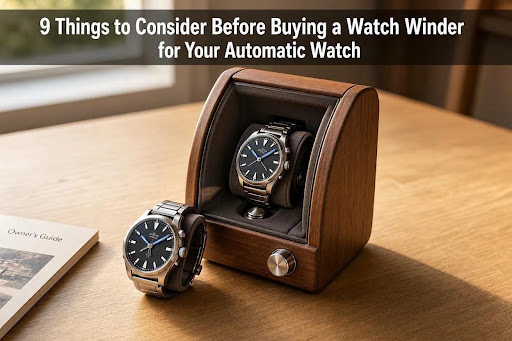
If you own an automatic watch, you already know the quiet frustration of picking it up after a few days off your wrist, only to find it’s stopped and needs resetting. A watch winder solves that problem, but not every winder suits every collection, and buying the wrong one can waste money or, worse, put unnecessary strain on your movement.
Here’s a practical, no-nonsense look at what actually matters when choosing a watch winder, based on how automatic movements work and what real collectors run into.
1. Understand Why Automatic Watches Need Winding at All
Automatic watches keep time using a rotor that spins with the natural motion of your wrist, which winds the mainspring and keeps the movement powered. Take the watch off for more than a day or two, and that power reserve runs out. The watch stops, and depending on the model, you may need to reset the time, date, and sometimes even the moon phase or other complications.
A watch winder mimics wrist motion when you’re not wearing the piece, keeping the mainspring wound and the movement running continuously. This matters most for watches with complicated calendar functions, where resetting can be fiddly and time-consuming.
2. Know the Difference Between Single, Double, and Multi-Watch Winders
The right size depends entirely on your collection, not on what looks impressive on a shelf.
- Single winders suit someone with one or two automatics they rotate between.
- Double winders work well for couples or collectors with a small but growing set.
- Multi-watch winders (six, eight, or more slots) make sense once you’re managing a genuine collection and want everything ready to wear at once.
Buying more capacity than you need adds cost without adding value. Buying too little means constantly repositioning watches, which increases wear on the winding mechanism over time.
3. Check the Rotation Settings (TPD and Direction)
This is where a lot of people get caught out. Every automatic movement has a manufacturer-specified number of turns per day (TPD) and a required winding direction — clockwise, counter-clockwise, or bidirectional. Using the wrong setting either under-winds the watch, leaving it under-powered, or over-works the mainspring unnecessarily.
A quality winder gives you control over both, rather than running on one fixed setting for every watch you own. If you’re buying for a specific brand, it’s worth checking the manufacturer’s recommended TPD before committing to a model.
4. Motor Quality Matters More Than Looks
It’s easy to be swayed by a winder that looks premium in photos, but the motor inside is what actually protects your watch. Cheap motors tend to be noisy, jerky, or inconsistent in their rotation, and a poorly built motor can introduce vibration that isn’t good for a delicate movement over months of continuous use.
Look for Japanese Mabuchi motors or similarly well-regarded mechanisms, quiet operation, and smooth, even rotation. This is genuinely one area where spending a bit more pays off, since the motor runs almost continuously for as long as the winder is in use.
5. Decide Between Battery and Mains Power
Most winders run on mains power, which is reliable but means the unit needs to stay near an outlet. Some models offer battery power as a backup or primary option, which is useful if you want to display the winder somewhere without a nearby socket, such as inside a dresser or display case.
If you travel with your winder or move it between rooms, battery compatibility is worth checking before you buy.
6. Think About Build Quality and Display Value
For many collectors, a watch winder isn’t just functional — it’s also part of how the watch is displayed. Leather or wood finishes, a glass viewing window, and soft interior cushioning all matter if the winder sits somewhere visible.
That said, build quality isn’t only about appearance. A well-made case reduces internal vibration, protects the watches from dust, and often includes better insulation for the motor, which extends the winder’s working life.
7. Compare Premium and Budget Options Honestly
This is where it helps to be realistic about what you actually need. A premium winder typically offers finer-grained TPD control, quieter and more durable motors, and better materials, while a budget option might only offer a single fixed rotation setting and a simpler case.
For a single everyday automatic, a mid-range winder is often perfectly adequate. For rarer or more delicate movements, particularly anything with complications, the extra investment in a premium winder tends to pay for itself by protecting the watch long-term. If you want a closer breakdown of where the real differences lie, this comparison of premium and budget watch winder options from Aevitas premium Luxury Vs Budget Watch Winders walks through the practical trade-offs in more depth.
8. Match the Winder to Your Specific Watches
Not every winder suits every case size or shape. Oversized cases, unusually shaped watches, or pieces with delicate bracelets need slots and cushions designed to accommodate them without pressure points. If you’re buying for multiple watches with different case diameters, look for adjustable cushions rather than a fixed one-size setup.
This is also a good moment to check a winder’s compatibility with popular movement types before buying, since some manufacturers publish detailed setting guides for major watch brands.
9. Buy From a Retailer That Understands Watches, Not Just Electronics
A winder is a long-term purchase sitting alongside genuinely valuable watches, so it’s worth buying from a retailer that specialises in horology rather than a general electronics seller. Specialist retailers are more likely to offer accurate TPD guidance, proper warranty support, and a range built specifically around real collector needs rather than generic gadget stock.
If you’re starting to look at options, it’s worth browsing a quality watch winders range built with these considerations in mind, rather than piecing together generic listings from unrelated sellers.
Final Thoughts
A watch winder is a small piece of equipment doing a fairly important job: keeping a mechanical movement running smoothly and saving you from constantly resetting complications. The right choice comes down to matching motor quality, rotation settings, and size to your actual collection, rather than buying based on price alone or what looks best in a display cabinet.
Getting it right protects watches that, in many cases, are worth considerably more than the winder itself. If you’re ready to explore your options, Shop Aevitas UK for a curated selection built around genuine collector needs.
FAQs
Do I really need a watch winder if I wear my watch every day?
No. If you wear the same automatic daily, your natural wrist movement keeps it wound. Winders are most useful for watches you rotate out of daily use or own multiple pieces you want ready to wear at any time.
Can a watch winder damage my watch?
Only if it’s poorly made or set incorrectly. A quality winder with the correct TPD and direction setting for your specific movement causes no more wear than normal daily use. Cheap, jerky motors or incorrect settings are what create risk.
How many turns per day (TPD) does my watch need?
This varies by manufacturer and movement, typically ranging from around 650 to 950 turns per day. Check your watch’s documentation or the manufacturer’s website for the specific figure rather than guessing.
Is it worth buying a multi-watch winder if I only own two automatics?
Generally, no. Buying capacity you don’t need adds unnecessary cost. A double winder covers two watches comfortably, and you can always upgrade later if your collection grows.
Should I leave my watch winder running all the time?
Most winders are designed for continuous operation and include rest cycles to avoid over-winding. Check the specific model’s settings, but running it consistently is normal and expected for most quality winders.