
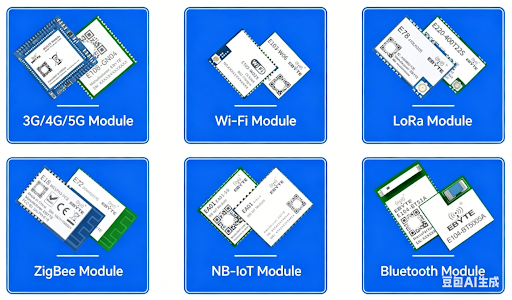
What is a Communication Module?
A communication module, also called a communication module, is an integrated circuit module used to enable data transmission between devices. Belonging to the category of integrated circuits, it is specifically designed for processing and transmitting data, thereby enabling data interaction between devices.
It possesses flexible adaptability and broad compatibility, and is typically built into various communication devices, such as mobile phones, routers, and IoT devices, responsible for receiving and sending signals. Through these modules, different devices can exchange data on 4G, 5G, WiFi, BLE, or other communication networks.
Communication modules are a core prerequisite for device networking. In the same application scenario, their integrated design makes device networking more convenient and less costly, making them an indispensable and important component of modern communication systems—without modules, a terminal is like an “island,” unable to report data or receive instructions.
Applications and Development Trends of Communication Modules
With continuous technological advancements and increasing application demands, the application of communication modules in various fields is constantly expanding. Their core development trends revolve around continuous optimization of adaptability and practicality, specifically as follows:
- Miniaturization: The increasing demand for miniaturization in portable devices and embedded systems has led to smaller communication modules. This not only improves device portability but also reduces manufacturing costs and power consumption, enabling communication modules to be widely used in various compact devices, such as smartwatches and portable medical devices.
- Low Power Consumption: With the widespread application of IoT devices, low power consumption has become a crucial development direction for communication modules. By reducing power consumption, devices can operate for extended periods without frequent battery replacements, which is significant for devices requiring long-term operation, such as remote monitoring systems and environmental sensors.
- High Performance: We live in an era of information explosion, making improved transmission rates and signal quality of communication modules a necessity. High-performance communication modules can support higher bandwidth and faster data transmission, meeting users’ demands for high-speed networks and playing a vital role in applications such as high-definition video transmission, online gaming, and big data transmission.
- Multi-mode: Modern communication modules typically support multiple communication protocols and frequency bands, enabling devices to operate in different network environments. This multi-mode support improves device compatibility and flexibility. For example, support for Wi-Fi, Bluetooth, and 4G/5G networks ensures stable connectivity in various scenarios.
- Intelligence: With the development of artificial intelligence and machine learning technologies, communication modules are also evolving towards intelligence. Intelligent communication modules can automatically select frequencies, manage channels, optimize communication efficiency, reduce interference and signal loss, and better adapt to complex and changing communication environments, thus improving device communication stability to a certain extent.
Communication Module Composition
Communication modules adopt an integrated design, combining multiple functional components into an independent, pluggable modular component. A complete communication module system mainly includes the following core components, which work together to ensure stable data transmission:
- Antenna: The antenna is the component in the communication module responsible for receiving and transmitting wireless signals. The design and performance of the antenna directly affect signal quality and transmission distance.
- Antenna Controller: The antenna controller adjusts the antenna’s direction and gain to optimize signal reception and transmission, which is crucial for maintaining stable operation of the communication module under various environments and conditions.
- Modem/Demodulator: The modem/demodulator is a core component of the communication module, used to convert digital data into analog signals suitable for transmission (modulation) and convert the received signal back to digital data at the receiving end (demodulation).
- Radio Frequency (RF) Circuit: The RF circuit handles the transmission and reception of wireless signals, including signal amplification and filtering, ensuring signal stability and clarity during transmission. Its performance directly affects communication quality and reliability.
- Intermediate Frequency (IF) Circuit: The IF circuit performs intermediate frequency processing on the signal, converting the signal before amplification and processing to reduce interference and improve signal quality.
- Baseband Processing Unit: The baseband processing unit is responsible for data encoding and decoding, ensuring accurate data transmission. Its functions include channel coding and decoding, data modulation and demodulation, signal processing, error detection and correction, etc. Its performance directly affects communication reliability and transmission efficiency.
- Interface Unit: The interface unit is used to connect and communicate with external systems or devices, enabling the communication module to be compatible with various hardware devices. This part typically includes low-speed serial ports, as well as high-speed interfaces such as USB and Ethernet.
Recommended Products
Ebyte wireless communication modules cover multiple communication standards including LoRa, Wi-Fi, Bluetooth, ZigBee, 4G/5G/NB/GPRS, LoRaWAN, CAN, and millimeter-wave radar. Multiple operating frequency bands are available. Developed in-house, the products offer comprehensive technical support. This series of modules has been widely used in service robots, industrial control and medical applications, smart homes, security alarms, environmental monitoring, and new energy fields. They are precisely adapted to various application scenarios of communication modules, balancing practicality and stability, and can meet the networking needs of devices in different industries.
Based on the technical characteristics and structural requirements of communication modules, as well as the core compatibility of Ebyte products, we recommend Ebyte’s full range of wireless communication modules. These modules are suitable for multiple scenarios and industries, aligning with the core development trends of miniaturization, low power consumption, high performance, and multi-mode operation in communication modules. Specifically:
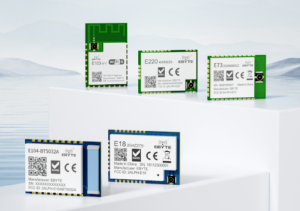
E104-BT5032A: Equipped with an nRF52832 chip, covering the 2402-2480MHz frequency band, with a transmit power of 4dBm, a maximum communication distance of 60 meters, supports BLE5.0 master-slave integration and data pass-through, and features serial port wake-up and over-the-air configuration. It is the preferred solution for low-power, short-range wireless transmission and smart device access.
E22-400M22S: Equipped with an SX1268 chip, covering the 410-493MHz frequency band, with a transmit power of 22dBm and a maximum communication range of 7km. It supports LoRa spread spectrum and industrial-grade crystal oscillators, featuring ultra-low power consumption and strong anti-interference capabilities, making it a preferred solution for medium- to long-range wireless communication and IoT node transmission.
E18-2G4Z27SI: Equipped with a CC2530 chip, covering the 2.4GHz frequency band, with a transmit power of 27dBm, supporting ZigBee 3.0 self-organizing and network self-healing, and featuring built-in PA+LNA signal enhancement, making it a preferred solution for smart homes and multi-device wireless networking.