
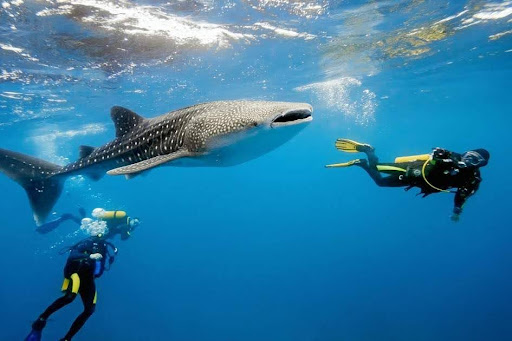
Ask any diver which encounters stay with them the longest and whale sharks almost always come up. There’s a reason for that. Diving with whale sharks puts you in the water with the largest fish on the planet — a creature that can stretch 12 metres or more — and yet the overwhelming feeling is not fear. It’s awe. Pure, quiet awe.
The Maldives has built its reputation as the world’s most reliable destination for whale shark encounters, and for serious divers, it’s hard to argue with that claim. Here’s everything you need to understand before you book your trip.
What Makes Diving with Whale Sharks Different from Snorkelling
Many whale shark encounters happen near the surface, which means snorkellers can participate too. But diving offers something fundamentally different.
When you’re beneath the surface on scuba, you can hold your position at depth and let the whale shark pass above you. You watch its enormous silhouette drift overhead — the white spots on its back catching the light, the tail sweeping in wide, unhurried strokes. You’re part of its world rather than looking down into it from above.
Diving also lets you stay longer. Snorkellers often have to swim hard to keep pace. Divers can hover effortlessly, control their buoyancy, and observe the animal calmly without disturbing it. For underwater photography, this makes an enormous difference.
If you’re a certified diver, diving with whale sharks — rather than snorkelling — is an experience on a different level entirely.
Why the Maldives Beats Every Other Destination
Whale sharks are found in tropical oceans worldwide. So why do experienced divers keep coming back to the Maldives specifically?
Year-round encounters. Most destinations have a narrow seasonal window. In the Maldives — particularly South Ari Atoll — whale sharks are present every month of the year. Scientists have identified a resident population of juvenile whale sharks that return to the same feeding grounds repeatedly. You don’t have to align your travel with a specific six-week window.
Shallow, clear water. Many encounters in South Ari Atoll happen at depths between 5 and 15 metres, in conditions with visibility stretching 20 to 30 metres. You can see the entire animal. You can see the reef below it, the baitfish around it, and the blue water beyond.
Protected area. South Ari Atoll falls within a designated Marine Protected Area. This legal protection shapes how tourism is managed — encounter rules are enforced, boat traffic is regulated, and the whale sharks are not harassed. The quality of encounters here is directly linked to how well the area is protected.
Resident behaviour. Maldivian whale sharks are accustomed to divers. They don’t bolt when approached correctly. They continue feeding. This means longer, calmer, more intimate encounters than you’ll find in destinations where the sharks are seasonal visitors passing through briefly.
Best Dive Sites for Whale Shark Encounters in the Maldives
South Ari Atoll Marine Protected Area (SAMPA)
The undisputed top spot. Year-round sightings, shallow depths, excellent visibility, and a resident population that returns to familiar feeding grounds. Peak encounter rates run from August through November, but no month is a write-off here.
Maamigili Corner (South Ari Atoll)
A reef edge where currents funnel in plankton-rich water and whale sharks cruise along the drop-off. Consistently good for underwater photography thanks to clear, well-lit conditions.
Rangali Madivaru (South Ari Atoll)
A nutrient-rich channel where whale sharks frequently feed near the surface. Dramatic encounters in open blue water, often with schools of reef fish swarming around the animal.
Dhigurah Bay (South Ari Atoll)
Calm, protected conditions close to shore. Ideal for divers who want a more relaxed encounter in shallower water, with frequent sightings throughout the year.
Machchafushi (South Ari Atoll)
A shallow reef platform that creates reliable feeding conditions. Particularly productive during the southwest monsoon season when plankton blooms are strongest.
What a Whale Shark Dive Actually Looks Like
You enter the water quietly — no splashing, no jumping. Your guide signals and you descend to a comfortable depth along the reef. Then the shape emerges from the blue haze: enormous, unhurried, completely at ease.
The whale shark’s mouth is open, filtering water as it moves. Small fish dart around its head and pectoral fins. The distinctive white spot pattern across its back is unique to this individual — researchers use these patterns to identify specific sharks across years of sightings.
You match its pace. You stay to the side and slightly behind, as the rules require. It glides past with slow, powerful sweeps of its tail. If you’re lucky, it turns and makes another pass. The whole encounter might last five minutes. It will feel like thirty seconds and stay with you for years.
The Rules Every Diver Must Follow
Whale sharks in the Maldives are protected, and responsible operators enforce strict encounter guidelines:
| Rule | Detail |
| Minimum distance | 3 metres from body, 4 metres from tail |
| No touching | Strictly prohibited — touching causes stress and can injure the animal |
| No flash photography | Startles the shark and disrupts natural behaviour |
| Entry position | Never enter in front of the shark or beyond its gills |
| Entry style | Quiet water entry — no jumping or splashing near the animal |
| No chasing | If the shark dives deep, let it go |
These rules exist to protect the whale sharks and to preserve the quality of encounters for everyone who comes after you. Operators who don’t enforce them aren’t worth booking with.
Do You Need a Specific Certification Level?
Open Water certification is sufficient for most whale shark dive sites in South Ari Atoll, given the shallow depths (5–15 metres) and generally calm conditions.
Advanced Open Water is recommended if you want flexibility for deeper sites, drift dives, and night dives during a longer liveaboard itinerary. It also makes the whole experience more comfortable — better buoyancy control means better encounters.
Dive insurance is mandatory on all reputable Maldives liveaboards. Book it before you travel.
Why a Liveaboard is the Best Way to Do It
Day trips from resorts work, but they come with constraints — fixed schedules, single sites, limited time in the water. A liveaboard removes all of that.
Aboard the Spirit of Maldives by Spirit Liveaboards, your itinerary is built around where the whale sharks actually are. The boat repositions daily based on guide knowledge, sightings reports, current conditions, and tidal patterns. If the best action is in one part of South Ari today and another tomorrow, you’re there.
You also get multiple dives per day — typically 3 to 4 — which dramatically increases your encounter rate compared to a single day trip. Add expert local dive masters, small group sizes for non-intrusive encounters, and a 40-metre luxury vessel with proper camera facilities, jacuzzi, and gourmet dining, and the liveaboard format isn’t just more convenient. It’s a genuinely better experience.
Frequently Asked Questions
Are whale sharks dangerous to dive with? No. They are filter feeders and pose no threat to humans. They are among the safest large marine animals you can encounter underwater.
What’s the best time of year to go? South Ari Atoll offers year-round encounters. August through November tends to see the highest encounter rates, but any month can deliver excellent dives.
How long does a typical encounter last? It varies — anywhere from two to ten minutes per shark, depending on the animal’s behaviour and how many divers are in the water. Multiple encounters in a single dive are not unusual in peak areas.
Can beginners dive with whale sharks? Yes. The shallow sites in South Ari are well-suited to Open Water certified divers. Your guide will brief you thoroughly and assess conditions before every dive.
Final Thought
Whale sharks don’t just pass through the Maldives. They live here. They feed here. They return to the same reefs season after season. That consistency — combined with protected waters, expert guides, and year-round conditions — is what makes the Maldives the place to come for this experience.
Plan it properly, choose a liveaboard that knows these waters, and go with patience. The encounter will take care of itself.