
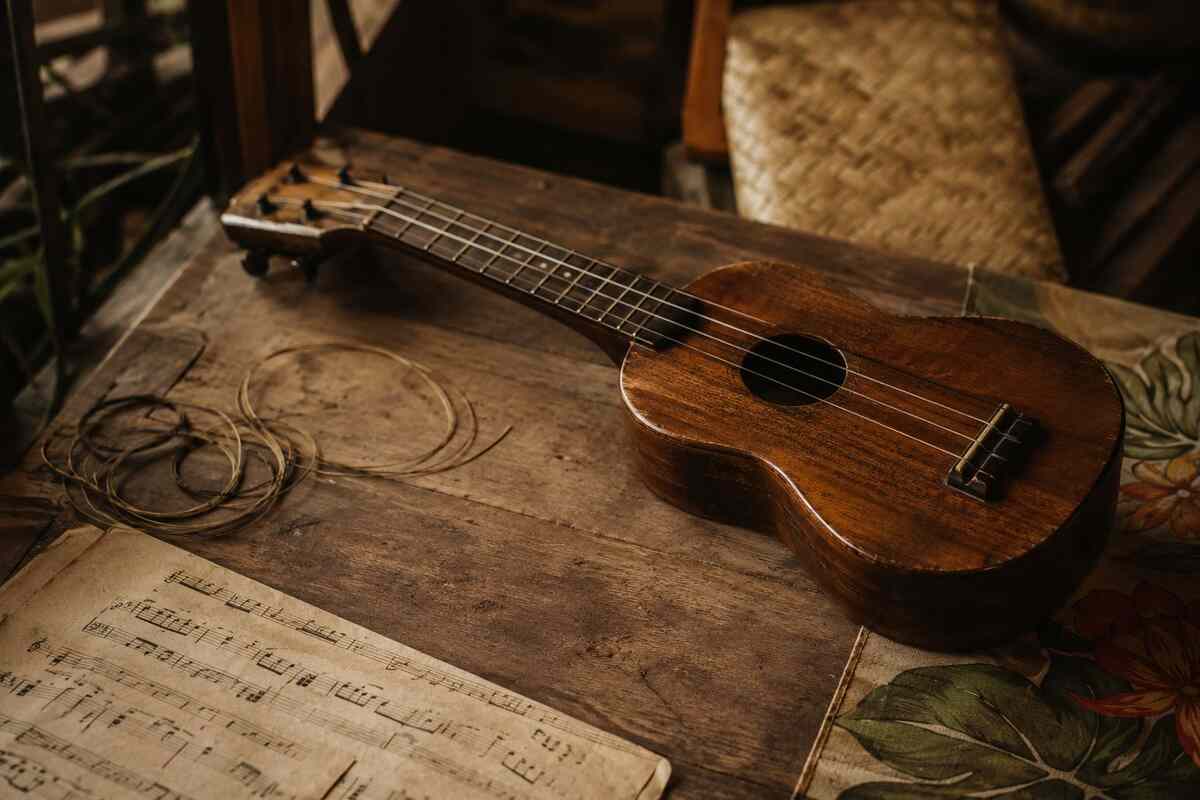
The ukulele has a longer story than most people expect. Its journey spans more than 140 years, from a small workshop in Portugal to Hawaiian royal courts, American jazz clubs, and now YouTube tutorials watched by millions. Understanding ukulele history means following that path step by step: how the instrument was built, who shaped it, and why it keeps finding new generations of players. Here’s the full timeline, along with the people and moments that made it happen.
What Is a Ukulele and Where Did It Come From?
A ukulele is a small, four-stringed instrument typically tuned G-C-E-A, with a body shaped like a miniature guitar. That compact size isn’t a design choice made for convenience. It comes directly from the instrument’s origins.
The ukulele descends from a family of small stringed instruments carried across the Pacific by immigrants in the late 1800s. What began as a portable folk instrument for everyday music became one of Hawaii’s most recognizable cultural exports.
The Portuguese Instruments That Inspired the Ukulele
Ukulele history doesn’t start in Hawaii. It starts on the Portuguese island of Madeira, where immigrants built small guitar-like instruments known as the machete (also called the machete de braga) and the braguinha.
These instruments shared several traits with what would later become the ukulele:
- Small, guitar-shaped bodies
- Four or five strings
- Bright, cheerful tone
- Easy portability for travelers and laborers
Madeiran craftsmen had built these instruments for generations, and their techniques for shaping, stringing, and tuning traveled with the people who knew how to make them.
1879: How Portuguese Immigrants Brought It to Hawaii
The clearest turning point in ukulele history is 1879, when the ship Ravenscrag arrived in Honolulu carrying Portuguese immigrants from Madeira. Many had come to work on Hawaii’s sugar plantations.
Among the passengers were skilled cabinet makers and instrument builders, including Manuel Nunes, Augusto Dias, and José do Espírito Santo. These three names appear again and again in accounts of the ukulele’s early development. Soon after arriving, they began adapting their traditional machete-building skills to Hawaiian koa wood, a native tree valued for its warm, resonant tone.
The instrument caught on quickly. Newspaper accounts from the time describe Hawaiians taking an immediate interest, and within a few years it had spread well beyond the Portuguese immigrant community.
How the Ukulele Got Its Name and Meaning in Hawaii
There’s no single confirmed origin for the name ‘ukulele.’ The word is Hawaiian and generally translates to ‘jumping flea,’ with a few competing explanations for how it earned that name, according to the national museum’s account of the ukulele’s origins.
- The finger-movement theory: the quick, hopping motion of a player’s fingers on the strings resembled a jumping flea.
- The Edward Purvis theory: a British army officer stationed in Hawaii, nicknamed “ukulele” for his small size and energetic movement, is said to have popularized the term through his playing.
- The gift-from-afar theory: some scholars connect the name to a Hawaiian phrase meaning “the gift that came here,” linking it to the instrument’s imported origins.
Whichever story is most accurate, the name had stuck by the 1880s and hasn’t changed since.
Early Hawaiian Craftsmen Who Shaped the Instrument
Manuel Nunes is often credited as the most influential of the original three luthiers. By the 1880s, he had opened his own shop in Honolulu to build and sell the new instrument. Augusto Dias and José do Espírito Santo followed similar paths, each building their own reputation and clientele.
These early builders refined the instrument through constant experimentation:
- Adjusting body shapes for better projection
- Testing different native woods
- Fine-tuning string tension for a brighter sound
- Standardizing the four-string configuration
Over roughly two decades, their work turned an imported folk instrument into something distinctly Hawaiian, built from Hawaiian materials and increasingly regarded as a Hawaiian invention.
Royal Support: How Hawaiian Royalty Popularized It
Royal endorsement did more than anything else to accelerate the ukulele’s rise. King Kalākaua, Hawaii’s monarch through much of the 1880s, was a devoted supporter of Hawaiian music and included the ukulele in royal performances, helping establish it as a serious cultural instrument rather than a passing novelty.
His successor, Queen Lili’uokalani, took this further. A musician herself, she composed music that incorporated the ukulele, including versions of “Aloha ‘Oe.” With royal patronage behind it, the instrument became tied to Hawaiian identity and cultural pride, a status it still holds today.
The 1915 Panama-Pacific Exposition and U.S. Popularity
If Hawaiian royalty gave the ukulele cultural legitimacy, the 1915 Panama-Pacific International Exposition in San Francisco gave it national fame. The Hawaiian Pavilion featured live ukulele and steel guitar performances that drew large crowds, many hearing the instrument for the first time.
The response was immediate. Mainland Americans embraced the sound, and sheet music publishers, instrument manufacturers, and touring musicians moved quickly to meet the demand. This event is widely seen as the moment the ukulele shifted from a regional Hawaiian instrument to a national American trend.
The Jazz Age Boom: Ukulele Fever in the 1920s
The 1920s marked the first true golden age of the ukulele. As jazz spread through American culture, the instrument fit naturally into the era’s fast, upbeat sound.
Several factors drove this boom:
- Vaudeville performers regularly featured the ukulele in their acts
- Sheet music began including ukulele chord diagrams alongside piano arrangements
- Manufacturers like Martin and Gibson started mass-producing ukuleles
- College students adopted it as a symbol of youth and modern culture
By the mid-1920s, hundreds of thousands of ukuleles were sold annually in the United States, a level of popularity the instrument wouldn’t reach again for decades.
Ukulele History in Music, Film, and Pop Culture
Beyond the 1920s boom, ukulele history runs through much of twentieth-century entertainment. Hollywood films of the 1930s and 1940s frequently used the instrument in tropical or romantic scenes, reinforcing its ties to Hawaii and escapism.
Performers like Arthur Godfrey brought the ukulele into American homes through radio and early television in the 1950s, sparking renewed mainstream interest. Decades later, Israel Kamakawiwoʻole‘s medley of “Somewhere Over the Rainbow” and “What a Wonderful World” became a global streaming hit, introducing the instrument to a new generation of listeners.
Each of these moments added a new layer to the ukulele’s identity, from novelty prop to genuine musical voice.
Post-War Decline and the 1960s Revival
Not every chapter of ukulele history moved forward. After World War II, changing musical tastes and the rise of the electric guitar caused ukulele sales to decline through the 1950s.
A brief revival followed in the 1960s, driven by:
- Continued television exposure, including Arthur Godfrey’s ongoing presence
- Renewed interest in folk and acoustic music
- The instrument’s affordability and accessibility for beginners
By the 1970s and 1980s, though, the ukulele had settled into a niche role, respected within Hawaiian music circles but largely overlooked by the mainstream industry.
Modern Ukulele History: From YouTube to Global Trend
The most recent chapter of ukulele history is also its most unexpected. Starting in the mid-2000s, online video platforms gave players a direct way to reach global audiences. Viral covers, tutorial channels, and affordable pricing turned the ukulele into one of the most popular first instruments for beginners worldwide.
A few factors have driven this resurgence:
- Affordable, well-built entry-level models from brands like Kala and Cordoba
- Widely available online tutorials that make self-teaching easy
- Its portability, appealing to travelers and casual musicians
- Ongoing celebrity and influencer visibility on social media
Today, the ukulele holds a place not only as a Hawaiian cultural symbol but as a genuinely global instrument, played across dozens of musical styles.
Key Milestones in Ukulele History: Quick Timeline Recap
- Pre-1879: Machete and braguinha instruments developed in Madeira, Portugal
- 1879: Portuguese immigrants bring these instruments to Hawaii aboard the Ravenscrag
- 1880s: Manuel Nunes, Augusto Dias, and José do Espírito Santo adapt the instrument using Hawaiian koa wood
- 1880s: King Kalākaua and Queen Lili’uokalani help establish it as a Hawaiian cultural symbol
- 1915: The Panama-Pacific Exposition introduces it to mainland America
- 1920s: The Jazz Age sparks the first mass-market ukulele boom
- 1950s–60s: Television exposure drives a mid-century revival
- 1970s–90s: A period of relative decline in mainstream popularity
- 2000s–present: Online video and affordable manufacturing spark a global resurgence
Frequently Asked Questions About Ukulele History
Where did the ukulele originally come from?
Its direct ancestors, the machete and braguinha, originated in Madeira, Portugal. Portuguese immigrants brought these instruments to Hawaii in 1879, where local craftsmen adapted them into the ukulele.
Who invented the ukulele?
No single person invented it. Portuguese immigrant craftsmen Manuel Nunes, Augusto Dias, and José do Espírito Santo are widely credited with developing it in Hawaii during the 1880s, building on traditional Portuguese designs.
Why is it called a ukulele?
The name translates roughly to “jumping flea” in Hawaiian, likely describing the quick finger movements of players. Some accounts also link it to a British officer nicknamed “ukulele” for his energetic playing style.
Is the ukulele a Hawaiian or Portuguese instrument?
Both. Its design and construction techniques originated in Portugal, but it was refined and culturally embraced in Hawaii, where it took on its modern identity.
When did the ukulele become popular in the United States?
Its first major wave of mainland popularity followed the 1915 Panama-Pacific Exposition in San Francisco, followed by a much larger boom during the Jazz Age of the 1920s.
Conclusion
Ukulele history is the story of a small instrument that kept finding new audiences. From Portuguese craftsmanship and Hawaiian royal support to American jazz clubs and modern online tutorials, each era added something new to its identity. Whatever draws you to the ukulele today, you’re part of a tradition that has been evolving and winning over new players since 1879.