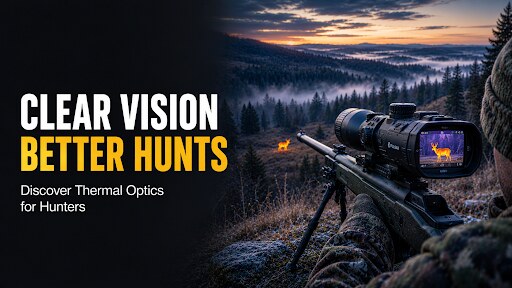
Hunting often takes place in conditions where visibility can change quickly. Early mornings, late evenings, dense vegetation, and changing weather can make it harder to observe the environment clearly. For hunters who want greater awareness in challenging conditions, thermal optics for hunters offer a different approach to seeing the landscape. Instead of relying only on visible light, thermal imaging detects differences in heat and displays them as a thermal image.
This technology can help hunters identify heat signatures against cooler backgrounds, making it possible to observe animals and surrounding terrain when traditional optics may become less effective. However, thermal optics are not simply about buying the most advanced device available. Understanding image quality, detection range, battery performance, ergonomics, and intended use is essential when choosing equipment for responsible outdoor activities.
How Thermal Imaging Works
Thermal imaging technology detects infrared energy emitted by objects. Everything with a temperature above absolute zero produces some level of infrared radiation, although the amount varies depending on its temperature.
A thermal device captures these differences and converts them into an image that allows the user to distinguish warmer objects from cooler surroundings.
For hunters, this can offer a useful alternative to conventional optical equipment. An animal may be difficult to spot visually when it blends into vegetation or when natural light is limited. Its heat signature, however, may still stand out against the surrounding environment.
This is one reason thermal imaging has become increasingly popular among outdoor enthusiasts.
Why Hunters Use Thermal Optics
Traditional optics remain valuable for many hunting situations, but they depend heavily on visible light and contrast. Thermal devices work differently.
Their ability to detect heat can help users observe potential targets and other warm objects in conditions such as:
- Low-light environments
- Early morning
- Late evening
- Dense vegetation
- Certain weather conditions
- Areas with limited natural visibility
This can give hunters greater situational awareness and help them understand what is happening around them.
However, thermal imaging should be considered an observation and detection technology rather than a guarantee of perfect visibility. Environmental conditions and the quality of the device can affect what the user sees.
Detection Is Not the Same as Identification
One important concept for anyone considering thermal equipment is the difference between detection and identification.
A thermal device may allow you to detect a heat source at a considerable distance. That does not necessarily mean you will be able to identify exactly what the object is.
The ability to recognise details depends on several factors, including:
- Thermal resolution
- Lens size
- Detection distance
- Target size
- Environmental conditions
- Image processing
A device may show that something warm is present, while a closer view or higher-resolution image may be required to determine what it actually is.
Understanding this difference can help hunters choose equipment with realistic expectations.
Choosing the Right Thermal Device
Not every thermal optic is designed for the same purpose. Before making a purchase, hunters should consider how and where they plan to use the device.
Important features may include:
- Thermal sensor resolution
- Detection range
- Refresh rate
- Image clarity
- Battery life
- Device weight
- Ease of operation
- Weather resistance
A lightweight device may be more comfortable during long outdoor trips, while a model with a larger lens may offer advantages for longer-range observation.
The best choice is therefore not always the device with the highest specification on paper. It is the one that matches the user’s needs, experience, and environment.
Image Quality Makes a Difference
Thermal imaging is all about interpreting heat patterns. Clear image quality can make this process easier.
A higher-resolution sensor may provide more detail, allowing users to distinguish shapes and heat signatures more effectively. Image processing technology can also influence how clearly different temperature variations appear.
When comparing devices, it is useful to consider the overall imaging system rather than focusing on a single specification.
A good thermal device should provide an image that is clear enough for the intended application and comfortable to view over extended periods.
Understanding Weather and Environmental Conditions
Thermal imaging can be useful in many challenging conditions, but it is not unaffected by the environment.
Rain, fog, humidity, wind, and other atmospheric conditions can influence thermal performance. Dense objects and certain materials can also block infrared radiation.
This means users should understand the limitations of their equipment and avoid assuming that thermal imaging can see through every obstacle.
Experience plays an important role. The more familiar a hunter becomes with their equipment and local environment, the better they can interpret what they are seeing.
Thermal Technology and Responsible Hunting
Technology should always support responsible hunting practices rather than replace them.
Thermal optics can help hunters observe their surroundings and improve awareness, but they should still follow all applicable hunting laws and regulations. Local rules may determine when and where thermal equipment can be used.
Hunters should also make ethical decisions and maintain positive identification before taking any action. Detecting a heat signature is not enough. The user must be certain of what they are observing and comply with all relevant regulations.
Responsible equipment use protects wildlife, supports ethical hunting, and helps maintain the reputation of the hunting community.
Nocpix — Exploring Modern Thermal Imaging Technology
For hunters and outdoor enthusiasts exploring thermal imaging technology, Nocpix offers a range of thermal imaging products designed for different applications.
Its product range includes thermal imaging solutions that can be relevant to hunting and outdoor observation, with different designs and capabilities intended to meet varying user requirements. Depending on the specific product, users can explore features related to image quality, portability, detection performance, and practical field use.
When selecting a thermal optic, it is still important to review the specifications of the individual model. Factors such as sensor resolution, lens configuration, battery performance, and intended application should all be considered before making a decision.
Final Thoughts
Thermal optics for hunters offer a new way to observe the outdoors by revealing differences in heat that may not be visible through conventional optics. This can be especially useful during low-light periods and in environments where traditional visibility becomes challenging.
However, choosing the right thermal device requires more than looking at maximum detection distance. Image quality, sensor resolution, battery life, portability, environmental performance, and ease of use all contribute to the overall experience.