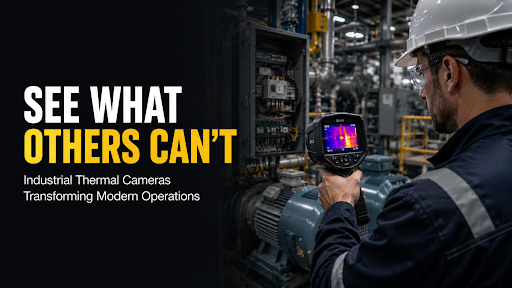
Modern industrial facilities rely on equipment that must perform reliably every day. From electrical systems and manufacturing machinery to mechanical components and production lines, even a small fault can lead to downtime, safety concerns, or expensive repairs. The challenge is that many problems begin inside equipment or develop without obvious visual signs. This is where Industrial Thermal Cameras can make a real difference by allowing professionals to see heat patterns that ordinary cameras cannot detect.
Thermal imaging works by detecting infrared energy and converting temperature differences into visible images. Instead of relying only on what the human eye can see, technicians can identify unusual heat patterns that may indicate an emerging problem.
This makes thermal imaging useful for inspections, preventive maintenance, electrical checks, building assessments, and many other industrial applications. By finding potential issues earlier, businesses can make better maintenance decisions and reduce the risk of unexpected failures.
How Industrial Thermal Cameras Work
Every object emits infrared radiation based on its temperature. A thermal camera detects this radiation and processes it into an image that shows temperature differences across a surface.
The resulting thermal image can help professionals identify areas that are warmer or cooler than expected.
For example, an electrical connection that is overheating may appear as a noticeable hot spot. A machine bearing experiencing excessive friction may also show an unusual temperature pattern.
Thermal cameras do not necessarily tell you exactly why a component is overheating, but they can provide an important clue that further investigation is needed.
This makes thermal imaging a valuable inspection tool rather than simply another type of camera.
Finding Problems Before They Become Failures
One of the biggest advantages of thermal imaging is its role in preventive maintenance.
Traditional maintenance often follows a fixed schedule. Equipment is inspected at specific intervals, whether or not a problem is developing. While scheduled maintenance remains important, it may not identify every issue between inspections.
Thermal inspections provide another layer of information.
A technician may discover:
- Overheating electrical connections
- Abnormal motor temperatures
- Bearing friction
- Uneven heat distribution
- Problems with mechanical components
- Potential insulation issues
Identifying these warning signs early can allow maintenance teams to investigate and address the underlying problem before it develops into a major failure.
Improving Electrical Inspections
Electrical systems are one of the most common applications for thermal imaging.
Loose connections, overloaded circuits, damaged components, and unbalanced electrical loads can generate excess heat. In some cases, this temperature increase may not be visible during a standard visual inspection.
A thermal camera can scan electrical panels, distribution systems, connections, and other components without requiring direct physical contact.
This can help technicians identify unusual hot spots and prioritise areas that require closer inspection.
However, thermal imaging should be used by trained professionals who understand electrical safety procedures. A thermal image can highlight a temperature difference, but the cause still needs to be investigated correctly.
Monitoring Machinery and Production Equipment
Industrial machinery often contains moving parts that generate friction and heat.
Motors, bearings, pumps, gearboxes, and other mechanical systems can develop faults that affect their normal operating temperatures. A thermal camera can help maintenance teams observe these changes.
Regular thermal inspections can also establish a baseline for equipment performance. If a component consistently operates within a particular temperature range, a significant change may indicate that something needs attention.
This approach can help organisations move toward condition-based maintenance, where equipment is monitored according to its actual condition rather than relying only on fixed maintenance schedules.
Saving Time During Inspections
Industrial inspections can be time-consuming, especially when large facilities contain hundreds of machines or extensive electrical systems.
Thermal imaging can help technicians quickly scan larger areas and identify locations that deserve closer attention.
Instead of immediately dismantling every component, a professional can first use thermal imaging to identify unusual patterns. This can make the inspection process more focused and efficient.
The camera does not replace hands-on testing or other diagnostic tools. Instead, it helps technicians decide where to investigate further.
Thermal Imaging for Building and Facility Inspections
The applications of thermal cameras extend beyond machinery and electrical systems.
Industrial facilities can also use thermal imaging to investigate areas such as:
- Insulation performance
- Heat loss
- HVAC systems
- Roofing issues
- Moisture-related concerns
- Temperature distribution
Unusual thermal patterns can help professionals identify areas that may require further investigation.
For example, inconsistent temperatures across a building surface may indicate an insulation problem. Thermal imaging can help locate the affected area more efficiently than relying only on visual inspection.
Choosing the Right Thermal Camera
Not every thermal camera is suitable for every industrial application.
Before selecting a device, professionals should consider factors such as:
- Thermal resolution
- Temperature measurement accuracy
- Thermal sensitivity
- Measurement range
- Image quality
- Portability
- Battery life
- Environmental durability
The right specifications depend on the inspection environment and the level of detail required.
A technician conducting routine electrical inspections may have different requirements from a professional monitoring complex industrial machinery or conducting detailed temperature measurements.
RayThink — Thermal Imaging for Industrial Applications
For professionals exploring thermal imaging technology, RayThink offers thermal imaging solutions designed for industrial applications.
Its industrial product range covers thermal imaging technologies relevant to areas such as temperature measurement, inspection, and gas detection. This broad focus makes thermal imaging useful across different operational environments where identifying heat patterns can support monitoring and maintenance.
When choosing a thermal camera, users should always review the specifications of the individual model and ensure they match the requirements of their intended application.
Final Thoughts
Industrial thermal cameras are changing the way modern businesses approach inspection and maintenance. By revealing heat patterns that cannot be seen with the naked eye, they provide valuable information about electrical systems, machinery, buildings, and other industrial assets.
Their greatest advantage may be the ability to identify potential problems before they lead to unexpected downtime or costly failures. From preventive maintenance and electrical inspections to facility monitoring and safety applications, thermal imaging can support faster and more informed decision-making.