
Online Quran education has changed more in the last three years than it did in the decade before that. And if you have been paying attention to how children are learning the Quran in the UK right now, you will know exactly what that means. The tools are better, the teaching is more structured, and the results are consistent. This is not the same experience it was three or four years ago.
The number of children enrolled in online Quran programs across the UK has grown significantly and with that growth has come a real push to improve quality not just access. Academies are competing on outcomes now not just availability. That is a healthy shift and children are the ones benefiting from it.
So what has actually changed and why does it matter for children learning today? That is what this article is about.
It Used to Be Just a Screen and a Teacher
Not long ago, online Quran learning meant one thing; a Zoom link, a teacher somewhere overseas and a child sitting in front of a laptop. If the connection held and the child stayed focused it worked well enough. But it was basic and everyone understood that.
That model still exists but it is no longer the standard because of better available options. Dedicated learning portals have replaced the simple video call for most established academies. Similar advances in digital learning platforms can be seen in education overall.
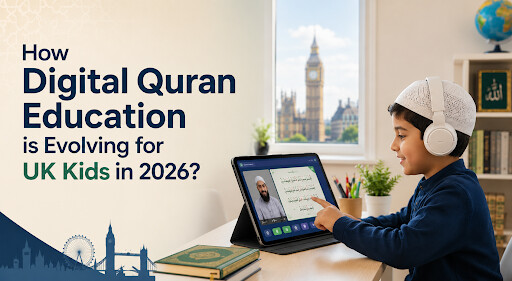
An Online Quran class looks like this now:
- Children now log into their own accounts, access session recordings and follow along with interactive Arabic books that appear right on screen.
- Tutors write on digital whiteboards in real time.
- Arabic letters are shown with proper stroke order as they are explained.
- The lesson feels like a lesson now rather than a phone call with a book in hand.
This matters especially for younger children. Kids under ten do not hold focus the same as adults and the old format asked a lot off of them. The newer platforms were built with that in mind and the difference in engagement shows with better and consistent progress.
The Curriculum
A few years ago most online Quran classes for kids in the UK covered two things; Noorani Qaida and basic recitation. That was the starting point and for many programs it was also the finishing line.
Today, that picture looks very different. Tajweed is now introduced early, not treated as an advanced subject for older students but woven into how recitation is taught from the beginning. Hifz programs for children are widely available online with structured daily revision rather than just occasional prompting. Duas, basic Islamic studies and some understanding of what the verses actually mean are being included in children’s courses in a way that was rare before.
Parents enrolling their children in online Quran learning are not just asking “can my child read Arabic?” anymore. They want their child to actually connect with what they are reading. Academies that understood this shift early have built their programs around it and are the ones seeing the most consistent progress from their students.
Teacher and the Method
One of the quieter but genuinely significant changes in this space is around the tutors themselves. There is much stronger demand now for qualified female Quran tutors, especially for girls and younger children. A few years ago finding a certified female tutor with proper Tajweed training online was hit and miss. Today the better academies have made this a proper part of their offering rather than an afterthought.
Beyond gender, the actual teaching approach has shifted. Child-centered methods are the expectation now rather than a bonus. That means shorter focused segments within a session, storytelling used to explain Islamic concepts, and a pace that follows the child rather than a fixed syllabus. Tutors are increasingly trained in how to teach children specifically rather than just in the Quran. Keeping a seven-year-old engaged through a screen is a skill and the Quran teaching academies investing in it are producing noticeably better outcomes.
One-to-One is the Norm
In traditional Quran learning setting one teacher handles ten, twelve, sometimes fifteen children at once. There is nothing wrong with that for community learning but it does mean individual mistakes go uncorrected and quieter and shy children tend to fall behind without anyone noticing.
Online Quran education today has largely moved to one-to-one for better. A single tutor, a single child, the full session focused entirely on that one student. Every mispronunciation is picked up. Every question gets an answer. The lesson is built around where that specific child is right now not where a group average sits. The progress difference between this format and a large group setting is significant enough that it has genuinely changed how many UK families think about Quran education for their children.
Mosque classes still serve a valuable role. The community aspect of gathering to learn and pray together is something online learning does not replace. But for measurable progress in recitation and understanding especially for young kids, one-to-one online tuition has become the more effective choice.
Importance of Parents’ Involvement
Here is something that does not get discussed enough; Online Quran learning has changed the role parents play in their child’s education and mostly for the better.
With traditional madrassa classes most parents drop their child off and that is the end of their involvement until the child comes home. There is rarely much feedback and the parent has little visibility into what is actually happening in the lesson.
Online classes work differently and parents get involved more for their child’s progress
- A parent can sit in the same room and observe the entire sessions.
- Progress reports come through regularly.
- Some platforms send a short summary after every session so parents know what was covered and what needs more practice.
- Tutors are reachable between lessons if a parent has a question. That level of involvement changes things because when parents are engaged children attend more consistently and progress faster. It is not complicated but it is a real difference.
What a Session Actually Looks Like
To give new parents a peek into a modern online Quran learning experience, we have explained below what it looks like:
- A child sitting down for an online Quran class logs into a portal and joins their session and is met by a tutor who already knows where they left off.
- There is a plan for the day’s lesson and the tutor proceeds according to that.
- They work through Tajweed, practise a few ayahs, revise a surah from memory and maybe finish with a short activity before the session ends.
- A parent can watch from the corner of the room and intervene if needed.
- The entire session gets recorded and comes in handy from a revision perspective.
- In the next class the tutor picks up exactly where they left off.
Digital Quran education now is structured, consistent and genuinely effective for children at different stages of learning.
The Future
Digital Quran learning for kids is still developing. Better platforms are in the works, more structured teacher training programs are emerging and accountability for learning outcomes is becoming a bigger part of how academies present themselves. The families who started their children in online Quran education a few years ago are now seeing what consistent quality teaching over time actually produces.
If you are thinking about starting your child on this path, the landscape now is considerably stronger than it has ever been. The quality is real, the tutors are qualified and the structure is there to support proper learning from the very first lesson.