
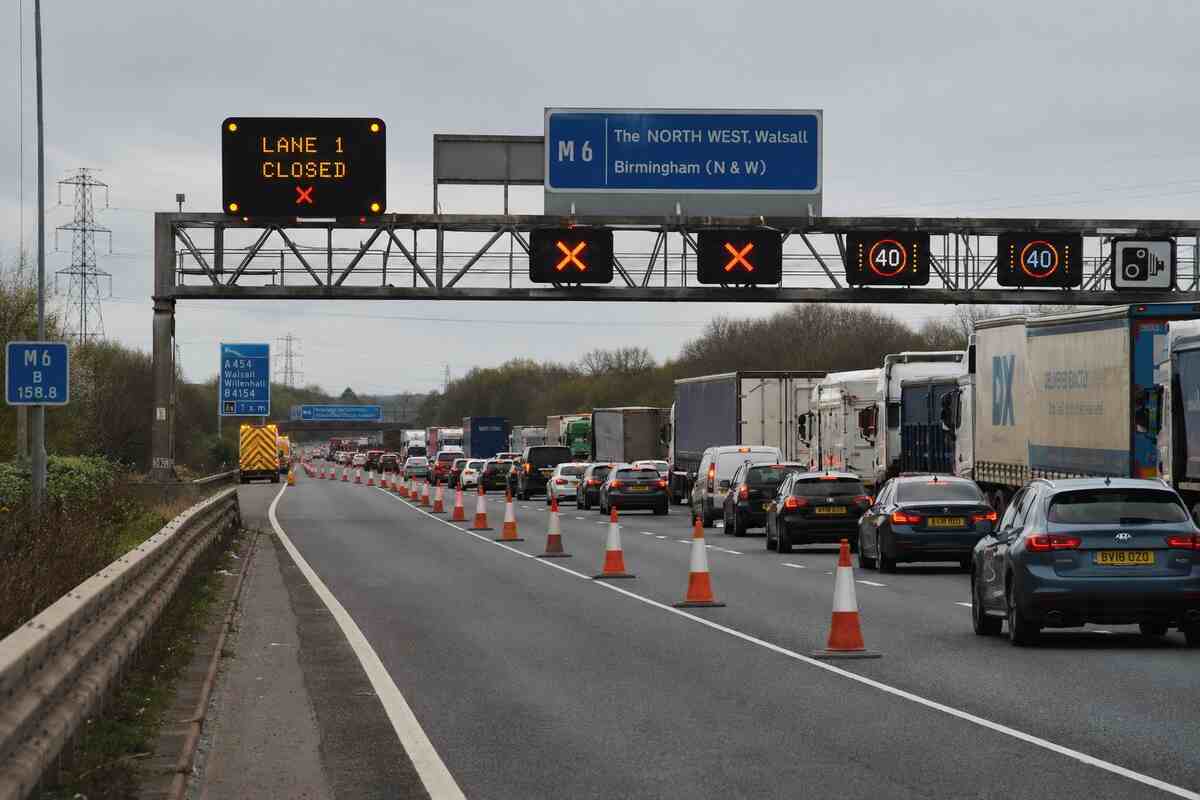
If you drive this stretch regularly, you know the pattern. Green light on your sat nav one minute, brake lights the next. The M6 Walsall Birmingham lanes closure is a phrase West Midlands commuters search almost on reflex, usually while stuck in traffic wondering what’s happened this time.
This guide covers why these closures happen, which junctions get hit hardest, how to tell roadworks from accidents, and what you can actually do to avoid losing an hour to standstill traffic.
What’s Causing the M6 Walsall Birmingham Lanes Closure?
There are three main causes behind most lane restrictions on this stretch. Planned maintenance and resurfacing are common, since the M6 carries heavy freight and commuter traffic that wears the surface down quickly. National Highways also runs bridge and structural work, including joint replacement between Junction 6 and Junction 7, which is essential but disruptive in the short term. During some infrastructure projects, contractors may use temporary bridge hire to maintain safe access while permanent bridge repairs or upgrades are carried out.
Accidents and breakdowns are the unpredictable factor. A collision or a broken-down HGV can shut a live lane with no warning, and recovery times vary from twenty minutes to several hours. Knowing which of the three is behind today’s delay helps you decide whether to wait it out or reroute.
Which Junctions Are Affected Between Walsall and Birmingham
A few junctions come up again and again in traffic reports. Junction 6 (Gravelly Hill) is one of the most complex interchanges on the network, Junction 7 (Great Barr) is a regular bottleneck for Birmingham-bound traffic, and Junction 9 (Wednesbury/Walsall) backs up fast even with a single lane closed.
Junction 10 and 10A, where the M54 link meets Walsall traffic, is another known pressure point. Delays don’t spread evenly across this corridor, so knowing which junction you’re passing through helps you judge how bad the disruption is likely to be.
Roadworks vs Accidents: Understanding the Different Closure Types
Roadworks are usually announced in advance and run to a set schedule, often overnight between 9pm and 6am. Check ahead and you can often avoid them completely by adjusting your travel time.
Accidents give no warning. A collision can close two or three lanes in seconds, with queues building before you even know something’s wrong. A useful tell while driving: a steady, unchanging speed limit on the matrix signs usually means planned works, while flashing warnings and sudden braking ahead point to an incident.
Current Lane Restrictions and Live Traffic Status
No article can tell you exactly what’s closed at the moment you’re reading it, since conditions on this stretch change constantly. What matters is knowing where to check before you set off.
National Highways’ West Midlands updates are the official source for planned works and live incidents. Traffic apps like Google Maps and Waze are useful for real-time rerouting, and local traffic radio is still genuinely helpful during rush hour. Check five to ten minutes before leaving rather than the night before, since conditions shift quickly.
How Long Will the Closures Last? Timeline and Reopening Dates
It depends on the type of closure. Scheduled maintenance and bridge works typically run for weeks or months but only restrict lanes during specific windows, usually overnight or at weekends, with full capacity restored at peak times.
Accident-related closures are far less predictable. Minor incidents can clear in thirty to forty minutes, while serious collisions requiring police investigation or recovery can shut a carriageway for hours. If you’re relying on this route for something important, build in ten to fifteen minutes of buffer time rather than trusting your sat nav’s estimate exactly.
Peak Hours and Expected Delay Times on This Stretch
Traffic on this corridor follows a fairly consistent daily pattern. Mornings between 7:30am and 9:30am are the worst for Birmingham-bound traffic, and the evening equivalent runs from around 4:30pm to 6:30pm, often worse if a daytime incident hasn’t fully cleared.
Overnight, from 9pm to 6am, traffic is lightest, but it’s also when most planned roadworks happen, so don’t assume it’s always clear. Even without active works, this section runs well above free-flow speed during peak hours purely because of volume.
Best Alternative Routes to Avoid the M6 Disruption
The M6 Toll bypasses the busiest section around Birmingham and can save real time during a major closure, though it comes at a cost. The M5 and M42 work for longer journeys that don’t need this exact corridor, but they can get congested themselves once traffic diverts during a serious M6 incident.
Local A-roads like the A34 and A5 suit shorter regional trips, since slower limits and traffic signals make them impractical for longer journeys. Check your traffic app before committing to a diversion, since alternative routes often fill up fast once everyone has the same idea.
How the Closure Affects Freight and Commercial Drivers
For commercial drivers, this corridor is a cost, not just an inconvenience. HGVs lose efficiency in stop-start traffic, fuel use climbs, and missed delivery windows can throw off an entire day’s schedule.
Many logistics companies now build extra time into their routing for this stretch and shift delivery windows to dodge peak-hour congestion. Checking National Highways’ planned works calendar weekly, rather than reacting last minute, helps avoid scheduling chaos.
Impact on Local Roads Around Walsall and Great Barr
Motorway closures rarely stay on the motorway. When drivers divert to avoid the M6, that traffic lands on local roads around Walsall and Great Barr, leading to longer queues at junctions and slower bus services.
Businesses along these routes can also see less footfall when getting there becomes harder. A closure listed simply as “M6 between J7 and J10” is really a wider regional traffic event, not just a motorway problem.
Tips to Plan Your Journey and Minimise Delays
A few habits make a real difference on this stretch:
- Check live traffic five to ten minutes before you leave
- Travel just before or after peak hours where possible
- Keep a backup route in mind rather than deciding mid-journey
- Use the M6 Toll for time-sensitive trips during major disruption
- Add buffer time on days with scheduled roadworks
None of these guarantee a smooth run, but together they cut the odds of getting caught out.
Where to Check Real-Time M6 Traffic Updates
For accurate, current information, a few sources are worth bookmarking: National Highways for official works and incidents, Google Maps or Waze for crowd-sourced congestion data, and local radio for commuting-hour bulletins.
Using more than one source at once usually gives the clearest picture, since official updates can lag slightly behind what’s actually happening on the road.
FAQs
Why is the M6 closed between Walsall and Birmingham?
Usually planned maintenance like resurfacing or bridge work, or an accident and breakdown requiring emergency lane closures.
Which junctions are most affected by M6 lane closures?
Junctions 6, 7, 9, and 10/10A see the most frequent restrictions, largely due to their role as major interchange points.
How long do M6 roadworks usually last?
Planned works can run for weeks or months but typically only restrict lanes overnight or at weekends. Accident closures are shorter but less predictable, often clearing within a few hours.
What’s the best alternative route during a closure?
The M6 Toll is the most direct bypass, while the M5, M42, or local A-roads suit shorter or less time-sensitive journeys.
How can I check live M6 traffic before I travel?
National Highways, traffic apps like Google Maps or Waze, and local radio bulletins are the most reliable sources.
Conclusion
The M6 Walsall Birmingham lanes closure is an ongoing part of driving one of the busiest, most heavily engineered motorway corridors in the country. Whether it’s scheduled bridge work or an unexpected accident, the disruption follows patterns you can plan around once you know what to look for.
Check live updates before you leave, know your alternative routes, and build in a little buffer time. Do that, and this stretch of the M6 becomes far less stressful, even on the days the cones inevitably show up again.